
Revised 11/1/2007
Chapter 5: Contents Summary Introduction Cases Interpretation Repeatability Chapter 6
Case #4: Worker in
Popcorn Factory
The patient is a 46 year old Caucasian male with one year history of progressive dyspnea with cough and occasional wheeze. He works with mixed flavorings at a Popcorn Factory. He smokes 1ppd. His chest radiograph reveals a few bibasilar interstitial markings.
Age 46 Height 6 ft 0 in Weight 165 lbs
| Actual | Pred | % Pred | LLN | |
| FEV1, Liters | 2.75 | 4.30 | 64% | 3.47 |
| FVC, Liters | 5.58 | 5.49 | 102% | 4.52 |
| FEV1/FVC, % | 49% | 79% | 69% |
| Actual | % Pred | % Change | |
| FEV1, Liters | 2.76 | 65% | +0% |
| FVC, Liters | 5.62 | 102% | +1% |
| FEV1/FVC, % | 49% |
Figure 5-4. Spirometry - Baseline (Blue) and Post Bronchodilator (Red)
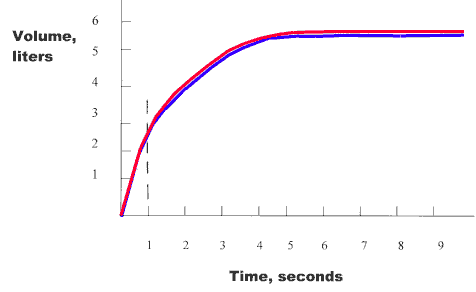
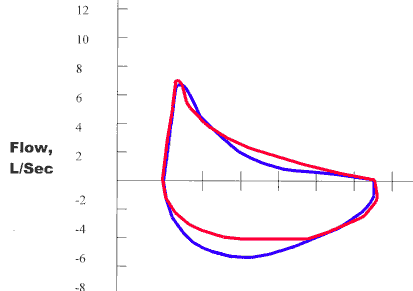
First, examine the FEV1/FVC% when compared to the LLN. Since the actual FEV1/FVC% is < LLN (49% < 69%), there is an obstructive lung defect present. Next, examine the FEV1 as % of predicted for severity of obstructive impairment. Since the value of FEV1 % of predicted is > 60% of predicted but < LLN (64% of predicted), then the degree of obstruction is "mild". Next, examine the FVC to determine if it is < LLN which would suggest restriction. Since the FVC is > LLN, there is no indication of a restrictive lung defect. The patient then had a treatment with a bronchodilator with repeat spirometry to determine if there was any bronchodilator responsiveness. The value of FEV1 has not increased (0%) and by only 10 ml. Thus, there is no significant response to the us of a bronchodilator (at least a 12% increase in FEV1 with at least 200 ml increase in FEV1). Therefore, the interpretation of spirometry for this patient is "mild obstruction with no significant response to the use of a bronchodilator."
Clinical Correlation: It appears that this patient may have bronchiolitis obliterans as a result of his work-place exposures at the Popcorn Factory. The finding of an obstructive lung defect with no responsiveness to the use of a bronchodilator would be consistent with a diagnosis of bronchiolitis obliterans, which is considered to be irreversible obstruction. Ultimately, a CT scan of the chest and/or lung biopsy might be needed to help confirm the diagnosis.