Interpretation Answer
In this test we will be using the FEV6
as a surrogate for the FVC. The FEV6
is obtained when the maneuver is shortened by terminating the maneuver after
only 6-seconds of exhalation. The FEV6
is not recommended for use in occupational testing.
The first step in interpreting results is to
determine if you have a valid test. In this test, we do
have three acceptable maneuvers, but we do
not have a
repeatable test. However, the lack of a repeatable test is
not a sufficient
condition to warrant failing to interpret the results -- particularly in patients
with airways obstruction who have a greater difficulty in producing a repeatable
test. In this case, the FEV1/FEV6% is
well below the LLN which would suggest an
obstructive pattern. However in these results, both the
FEV6 and FEV1 are
greater than 120% or the predicted values. Since 100% is the average percent predicted in a normal
population, these results are not consistent with an obstructive lung disease
pattern.
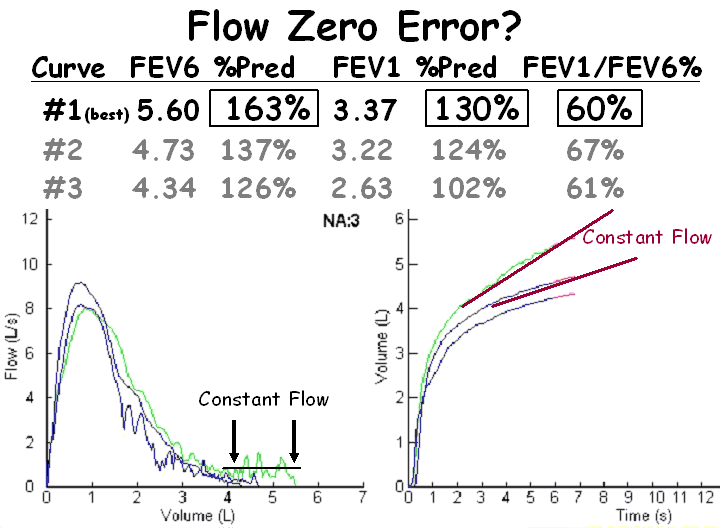
The explanation for these results is a flow zero
error for the following reasons:
1. The test in not repeatable, particularly FEV6
(FVC).
2. The percent predicted values (FEV1 and particularly FEV6
or FVC) are above 120% with
a low FEV1/FEV6
(FEV1/FVC%).
3. The volume is constantly increasing or there is a constant flow (see lines on
graphs). Even with airways obstruction, the volume-time curve should
eventually plateau. However, it is difficult to determine if the curve
would not have eventually exhibited a plateau when only a 6-second maneuver is
performed. Some individuals, particularly those with airways obstruction,
may require longer than 6-seconds to reach a plateau. This is one of
several reasons why the shortened maneuver of only 6-seconds
(FEV6)
is not recommended for use in occupational testing as a surrogate for
FVC.
Although the above criteria may occur without a
flow-zero error, to see all three conditions in the same test is highly
suggestive of a flow zero error.
Zero Errors can occur due to
faulty electronic zeroing
of the pressure transducer, resulting in either a
false steady
increase in flow or a
false steady decrease in flow much like a leak.
Although it is dependent on the type of flow-spirometer, usually the faulty
zeroing occurs when the sensor is moved or air is allowed to flow through the
sensor while a zero is being determined.
The test should be repeated, taking
greater care to keep the flow sensor still, without any air flowing through the
sensor, while the instrument is performing a flow zero. Regardless of
whether there is a flow-zero error, the lack of a repeatable test would
suggest some caution in interpreting the results as a mild obstructive
lung disease pattern.
Return