Revised 11/1/2007
Chapter 5: Contents Summary Introduction Cases Interpretation Repeatability Chapter 6Interpretation Algorithm Printer Friendly Copy
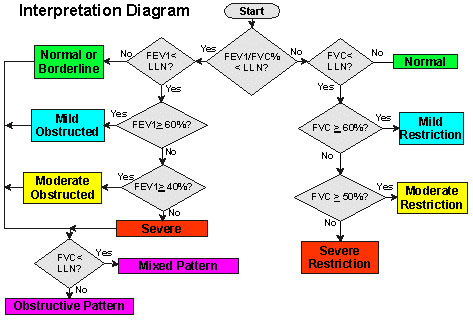
The interpretation of spirometry results can be done using the above algorithm. First, begin by determining if there is an obstructive lung defect by comparing the actual FEV1/FVC % to the lower limit of normal (LLN) for that value. If the FEV1/FVC % is less than the LLN, then there is the presence of obstruction. To determine the severity of obstruction, examine the left side of the algorithm to determine the FEV1 % of predicted and whether the obstruction is mild (value of FEV1 % is < LLN but > 60% of predicted), moderate (FEV1% is < 59% of predicted but > 41% of predicted), or severe (FEV1% < 40% of predicted). If the FEV1/FVC % is < LLN but the FEV1% is > LLN, this could be a normal variant or considered to be borderline obstructed. Then, to determine if there might be a restrictive lung defect, compare the actual FVC to its LLN. If the FVC < LLN, then there is the suggestion of a restrictive lung defect. The severity of restriction is determined by examining the right side of the algorithm as noted: mild restriction if FVC is < LLN but > 60% of predicted; moderate restriction if FVC is < 59% of predicted but > 51% of predicted; and severe restriction if the FVC is < 50% of predicted. Spirometry can only suggest the presence of a restrictive lung defect; it would require measurement of lung volumes to confirm the diagnosis of a restrictive lung defect.
By using the algorithm, it can be seen that the results of spirometry can be normal (no obstruction or restriction), an obstructive lung defect, a restrictive lung defect, or a mixed pattern with obstruction and restriction.